Buying Guides
Contemporary Kitchen Ideas That Still Work in Ten Years

By the Hill & May team
Updated 2026
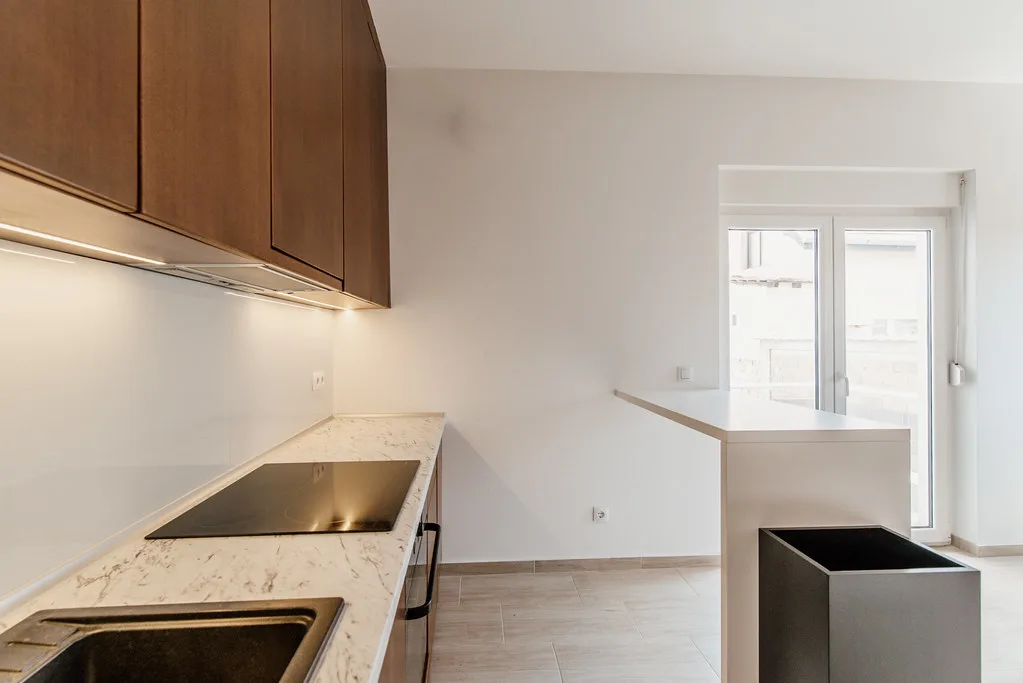
A contemporary kitchen is not the same thing as a fashionable one. The contemporary look that has settled in British homes over the past few years is quieter than the high-gloss white boxes of a decade ago: flat or lightly ribbed doors, no handles or very discreet ones, warm rather than cold neutrals, and a worktop that carries most of the visual weight of the room. It reads as calm, and it is designed to sit alongside the living space rather than shout across it.
This page covers the decisions that actually define a modern kitchen, which of them age well, and one material question that changed in May 2026 and that no showroom will raise with you unprompted.
The door decides everything else
Cabinet doors are roughly 60 to 70 per cent of what you see in a finished kitchen, which is why the door style sets the whole tone and why changing your mind later is expensive.
Slab doors are the contemporary default: a flat front, no frame, no moulding. They are the cheapest style to make well and the most unforgiving of poor manufacture, because a flat door shows every misaligned gap. Judge a slab kitchen on the consistency of its shadow gaps, not on the finish of the sample.
Handleless comes in two forms and they are not the same. A J-pull or rail profile is routed into the door or built into the carcase, so your fingers hook under the top edge. A push-to-open system uses a sprung catch and no visible cut at all. Push-to-open gives the purest line, but the mechanisms are the part most likely to annoy you in year five, particularly on heavy drawers. Rails are duller to look at and considerably more robust.
Ribbed and fluted fronts are the texture of the moment, usually on an island or a tall bank rather than everywhere. Used across a whole kitchen they read as a trend statement and will date; used on one run against plain doors they add depth without committing you.
Howdens groups its current ranges into five looks, and its architectural style is the mainstream contemporary one: slab or handleless cabinetry in neutrals, timber or metallics, with integrated appliances and hidden storage. If you want to weigh the modern option against a more traditional frame, we have set that out in in-frame versus handleless kitchens.
Colour has moved warm, and that is the durable part
The stark white and cool grey era is over. The palette that has replaced it is warm and slightly muted: putty and greige, clay and terracotta pinks, caramel and toffee, olive and deep forest green, and a warm charcoal in place of flat black. Bold deep blues and greens hold up well on a base run or an island with lighter walls above.
The reason this shift is likely to outlast the usual trend cycle is that warm neutrals are forgiving. A greige door works under LED lighting at 2700K, under daylight, and next to oak, brass or black. A cool grey door needs the light and the flooring to agree with it, and when they do not, the kitchen looks grey in the bad sense.
Matt finishes have taken over from gloss almost completely, and not only for looks: matt hides fingerprints and light scratching far better than a high-gloss lacquer, which is the single most common regret people report about mid-2010s kitchens. There is a fuller breakdown by shade in our kitchen colour ideas, and specific write-ups on sage green and grey.
Worktops: what changed in May 2026
Engineered stone, sold as quartz, has been the default contemporary worktop for years. Light background, subtle veining, matt finish, hard-wearing surface. It still is, and it still performs well in a kitchen.
The issue is not the finished worktop in your home. It is the cutting. Engineered stone can contain up to 95 per cent crystalline silica, and when it is cut, drilled or polished dry, the respirable dust causes silicosis, an incurable lung disease. On 11 May 2026 the Health and Safety Executive published its first COSHH guidance sheet specifically for engineered stone and stated plainly that dry cutting is unacceptable: water suppression is how businesses meet their legal duty unless they can show something equally effective. HSE’s own figures put respirable silica exposure from dry fabrication at five to ten times higher than wet methods. It also began a programme of more than 1,000 fabricator inspections across Great Britain running through 2026/27. Mike Calcutt of HSE put it as directly as a regulator can: “Silicosis is incurable, but it is entirely preventable.”
What that means for you as a customer is short and worth saying out loud in the showroom:
- Ask whether your worktop supplier fabricates in-house or subcontracts, and whether all cutting is done wet with water suppression.
- If anything needs adjusting on site, for a tap hole or a scribe, insist it is cut wet with extraction, not dry with an angle grinder in your utility room. This is the highest-risk moment in the whole process and it happens in people’s houses.
- Ask whether a low-silica version of the range is available. HSE lists switching to low-silica stone first among the employer controls, and most large manufacturers now offer one.
None of that means you should avoid quartz. It means you should choose a fabricator who can answer the question. If you would rather sidestep it, the contemporary alternatives are porcelain (very hard, thin, heat-proof, and far lower in silica), solid timber (warm, repairable, needs oiling), and stainless steel (industrial, scratches into a patina).
Layout is the part people underspend on
A contemporary kitchen lives or dies on circulation, not on doors. Three things are worth more than any finish upgrade:
Enough gap around an island. Allow around a metre of clear floor between an island and the runs on either side, and more on the side where the dishwasher and oven doors open. A cramped island is worse than no island. Our kitchen island ideas covers the sizes that work.
Drawers instead of cupboards in the base run. Deep pan drawers on full-extension runners cost more than doors with a shelf and are the upgrade nobody regrets. You can see the back of them without kneeling.
Tall units as a bank, not scattered. Contemporary design gathers the fridge, freezer and ovens into one full-height wall so the rest of the room can stay low and open. It is why integrated appliances matter to the look: a floating stainless fridge breaks the line the whole scheme depends on.
For the wider decision on where things go, start with our kitchen layout ideas and the open plan kitchen guide.
Where a range cooker fits a modern kitchen
A traditional cast-iron range in a slab-door kitchen is a deliberate contrast, and it can work beautifully, but it is a statement rather than a neutral choice. If you want the cooking capacity of a range without breaking a contemporary line, two options do it well.
A stainless or matt black 90cm or 100cm range cooker in a plain finish reads as an appliance rather than a period feature, especially in an integrated-handle kitchen. See our 90cm picks and 100cm picks.
An induction range cooker goes further: a single sheet of black glass across the top with no burners, trivets or grates to interrupt the surface. It is the flattest, quietest top a range can have, it is the easiest to wipe, and it suits a handleless kitchen better than anything else. We have covered the trade-offs in the induction range cooker guide and compared the fuels in gas vs electric vs induction.
Whatever you choose, size the extraction to the cooker rather than to the cabinet opening, and plan the ducting run before the plasterer arrives. Recirculating a 100cm range is a compromise you will smell every Sunday. Our cooker hood buying guide explains the sizing.
What dates fastest
Judged against kitchens fitted five and ten years ago, the elements that look tired soonest are consistent:
- High-gloss doors, particularly in white or cool grey.
- A single trend texture used everywhere. Fluted fronts on every door will look like 2026 the way raised-panel oak looks like 1998.
- Coloured LED strip lighting under the plinth. Warm white under wall units earns its place; colour-changing does not. See the kitchen lighting guide.
- Very dark matt worktops in a small kitchen, which show every crumb and every water mark.
- Open shelving used for storage rather than display. It photographs well and lives badly.
The safest contemporary kitchen is a quiet one: warm neutral doors, one texture used once, a worktop you can maintain, generous drawers, and money spent on the carcases and runners you never see. Add personality with the things you can change in a weekend, which is to say handles, splashback, lighting and paint above the units.
For what the whole thing is likely to cost, we have broken it down in the kitchen renovation cost guide.
Frequently asked questions
What is the difference between a contemporary and a modern kitchen? In everyday use the terms are interchangeable, and both usually mean flat or handleless doors, integrated appliances and minimal ornament. Strictly, “modern” refers to a mid twentieth century design movement, while “contemporary” just means what is being designed now, which is why contemporary shifts and modern does not.
Are handleless kitchens practical for a family? Rail and J-pull profiles are, and they are easy to clean because there is nothing to catch grease. Push-to-open catches are the weak point on heavy drawers and on doors that get kicked shut. If you have young children, choose the rail.
Is quartz still a safe worktop to buy in 2026? The finished worktop in your kitchen is inert and safe. The risk is to the workers cutting it. Since HSE’s guidance of 11 May 2026, dry cutting of engineered stone is unacceptable and water suppression is the expected control. Ask your supplier how they fabricate, insist on wet cutting for any on-site adjustment, and ask whether a low-silica version of the range exists.
What colour kitchen will not date? Warm neutrals: putty, greige, mushroom, soft clay. They work under different lighting and next to almost any timber or metal, which is what durability really means in a kitchen. Deep green and deep blue have held up well for several years and are lower risk than a bright accent colour.
Do contemporary kitchens work in an older house? Yes, provided you let the room keep its proportions. Handleless doors under a high Victorian ceiling look fine; what jars is filling the room to the cornice and losing the window reveals. Keep the tall bank on one wall and leave breathing space.
Can I have a range cooker in a handleless kitchen? Comfortably. A plain stainless or matt black range reads as an appliance rather than a period piece, and an induction range with a single sheet of glass on top is arguably the most contemporary cooking surface you can fit.