Buying Guides
Traditional Kitchen Designers: What to Check Before Deposit

By the Hill & May team
Updated 2026
Most advice about traditional kitchen designers stops at “visit a few showrooms and get three quotes”. That is not much use when you are about to hand over five figures to someone whose drawings you have not seen, on a contract you may not be able to cancel. This page is about the things you can actually verify before the deposit leaves your account, and the two or three that will cost you real money if you get them wrong.
The headline one, because it surprises nearly everybody: a bespoke kitchen ordered in your own home almost certainly comes with no 14-day cooling-off period. That is not a rogue trader’s small print, it is the law, and it is in the regulations below.
What “traditional” means to a designer, and why it changes the quote
Before you can judge a designer you need to be specific about what you are asking for, because “traditional” covers several quite different jobs.
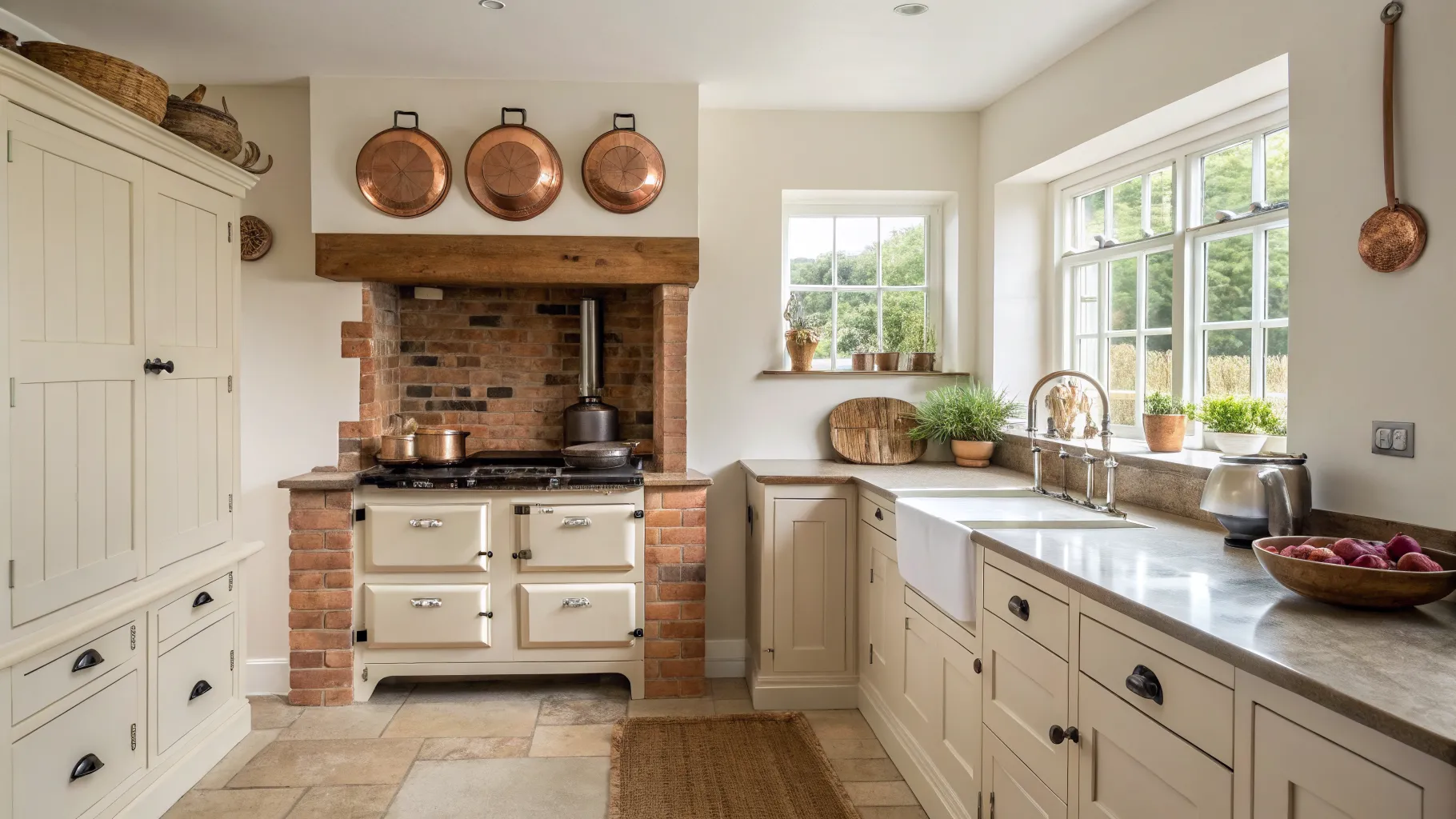
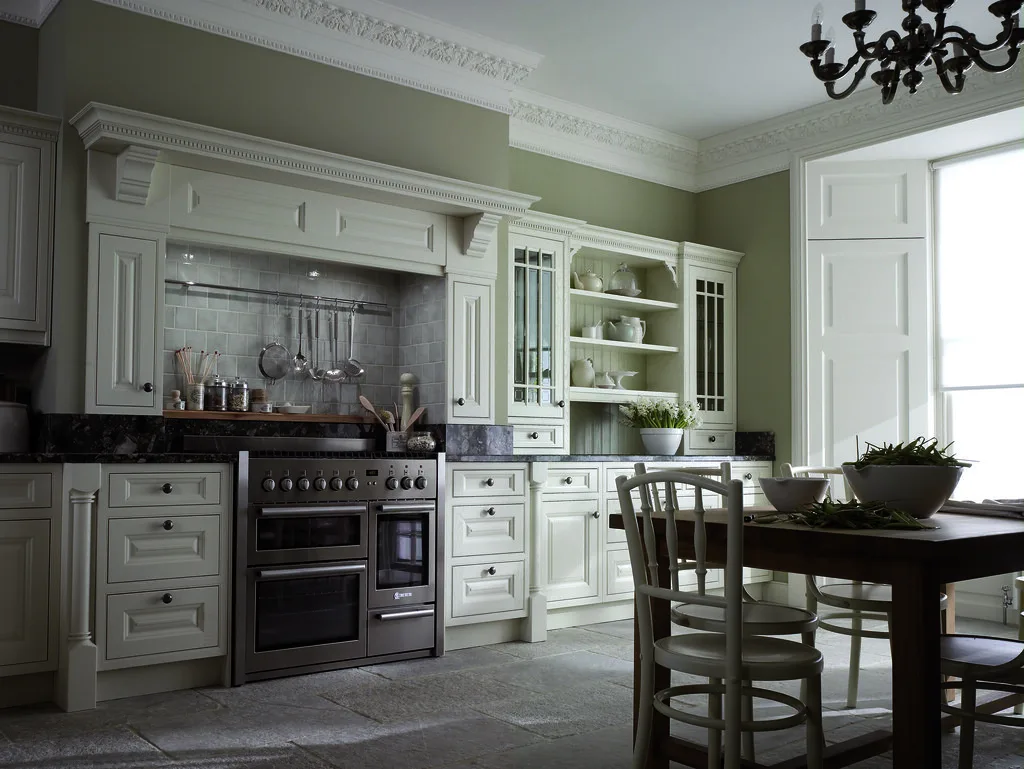
In practice, a traditional British kitchen usually means some combination of in-frame doors sitting inside a visible face frame rather than overlaying the carcase, painted timber rather than foil-wrapped MDF, cornice and pelmet, a plinth to the floor, a butler or Belfast sink, and a range cooker treated as the focal point of the room rather than an appliance slotted into a run.
That list matters because in-frame construction is the single biggest cost driver in the whole category. It needs more accurate carcases, tighter tolerances and a joiner’s approach to scribing into out-of-square walls, which is exactly the situation in most older houses. Our comparison of in-frame and handleless construction explains why one costs so much more than the other, and the shaker kitchen guide covers the door style most people actually mean when they say traditional.
Tell a designer “traditional” and you may get a shaker door on a standard carcase. Tell them “in-frame, painted, with a freestanding dresser and a 110cm range” and you will get quotes that can be compared with each other.
The three kinds of people calling themselves a kitchen designer
The independent showroom designer. Usually the owner or a long-serving employee of a local business, working with two or three manufacturers. This is where most genuinely traditional work sits, because in-frame ranges tend to come from smaller British makers rather than volume brands. You get one person from survey to snagging, and their reputation is local and checkable.
The national retailer’s designer. Employed by a chain, working from that chain’s catalogue, often paid partly on commission and working to sale deadlines. The design software is excellent and the showroom is convincing. The constraint is that the answer to every problem has to exist in one catalogue.
The online kitchen designer. A remote service, sometimes a genuine design consultancy and sometimes a plan-drawing service attached to a supplier. It can work well if you have a simple rectangular room, accurate measurements and you are supplying your own kitchen fitter. The problem in an old house is that nobody has been to your house. The KBSA’s own guidance for choosing a retailer is blunt about this: if they do not insist on a site survey before quoting, walk away there and then. A period property with a chimney breast, a sloping floor and a wall that is 40mm out over three metres is not a job for a plan drawn from your measurements.
If you do use an online kitchen designer, treat the drawings as a starting point and pay a local fitter to survey the room before anything is ordered. The cost of that survey is trivial against one wrong run of units.
The checks that are worth doing
Trade body membership, checked properly. The Kitchen Bathroom Bedroom Specialists Association (KBSA) requires full retailer members to operate a physical showroom and to work to a code of conduct. Useful, but here is the part almost nobody reads: KBSA membership on its own does not mean your deposit is protected. Its ConsumerCare scheme is optional for members, and the association says plainly that “not all members offer deposit protection” and tells you to check the member’s profile on its site for a small shield icon. Where the protection does apply, it covers up to 25% of the total contract price, or the deposits actually paid, or £18,750, whichever is lowest, if the retailer ceases to trade.
So the check is not “are they KBSA?” It is “are they KBSA, and does their profile carry the shield?”
The installer, separately. Kitchen fitting is not a regulated trade in this country. Anyone can call themselves a kitchen fitter tomorrow. The relevant register changed name recently and a lot of older advice still points at the old one: BiKBBI, the British Institute of Kitchen, Bedroom and Bathroom Installers, became BIFIS, the British Institute of Fitted Interiors Specialists, on 1 October 2025. The old bikbbi.org.uk address now redirects there. It is a government-sanctioned body that registers and vets installers, and its register is searchable by area.
The regulated trades within the job. Two parts of a kitchen fit are not a matter of opinion. Gas work must be done by a Gas Safe registered engineer, and the registration is checkable by number on the Gas Safe website. Electrical work in England is narrower than people assume: since April 2013 kitchens are no longer a “special location”, so moving a socket is not notifiable, but installing a new circuit or replacing the consumer unit is. Putting in a dedicated cooker circuit for a new range counts as a new circuit, so if your design involves one, ask who is notifying it and how you will get the certificate. Scotland and Wales operate different regimes.
Their actual work, in a real house. Ask to visit a completed kitchen. KBSA’s guidance suggests exactly this, and a designer confident in their fitters will arrange it. Photographs prove a camera angle. A three-year-old painted in-frame kitchen in a real family house proves the paint finish and the hinges.
Your legal position is weaker than you expect
There is usually no cooling-off period on a bespoke kitchen. Under the Consumer Contracts (Information, Cancellation and Additional Charges) Regulations 2013, contracts agreed in your home normally carry a 14-day right to cancel. But regulation 28(1)(b) removes that right for “the supply of goods that are made to the consumer’s specifications or are clearly personalised”. A bespoke kitchen, cut to your room, in your chosen paint colour, is the textbook example. Sign in your kitchen on a Friday evening and by Saturday morning you may have no statutory way out at all. Whatever cancellation terms the contract itself offers are then the only ones you have, which is why they are worth reading before you sign rather than after.
Pay the deposit on a credit card. Section 75 of the Consumer Credit Act 1974 makes the card issuer jointly liable with the retailer for misrepresentation or breach of contract. The commonly quoted limits are widely misunderstood: the Act says the protection does not apply to a claim “so far as the claim relates to any single item to which the supplier has attached a cash price not exceeding £100 or more than £30,000”. The cap is on a single item’s cash price, not on your total order. A £45,000 kitchen made up of individually priced units and appliances is not shut out of section 75 by its total. Paying even part of the deposit on a credit card triggers the protection for the whole purchase.
Keep the deposit proportionate. KBSA sets 25% as the ceiling for its full retailer members, and 25% is a reasonable line to hold generally. A designer asking for 50% before a survey has been done is asking you to fund their cash flow with an unsecured loan.
Get the payment schedule in writing, tied to events. Deposit on order, a stage payment on delivery of goods to site, the balance on completion and sign-off. Never on dates alone, because dates slip and delivery to a warehouse is not delivery to you.
Design fees, drawings and who owns them
Many good traditional designers charge a design fee, often a few hundred pounds, and most credit it against the order if you go ahead. That is a reasonable arrangement: a proper survey and set of drawings is a day or more of skilled work, and a designer who gives it away free is recovering it inside the price of the units.
Two things to settle in writing before you pay it. First, whether the fee is refundable or redeemable, and against what. Second, what you are allowed to do with the drawings. Copyright in design drawings normally stays with the designer unless the contract assigns it to you, so taking one firm’s plan to a cheaper supplier is both a commercial insult and potentially an infringement. If you want the freedom to shop the design around, negotiate that at the start and expect to pay more for it.
Working with a designer once you have chosen one
Do the survey properly and be there for it. Point out the damp patch, the boxed-in soil pipe, the floor that drops towards the back door. Every one of those is cheaper to design around than to discover on fitting week.
Decide the cooker first. In a traditional kitchen the range is the anchor: it sets the chimney breast or the recess width, the extraction, the fuel supply and often the entire layout. A 110cm dual fuel range needs a different plan from a 90cm induction one, so settle it before elevations are drawn rather than after. Our kitchen layout ideas cover how the rest of the room then falls into place.
Ask for elevations, not just a 3D render. Renders sell kitchens. Elevations, drawn to scale with heights and dimensions, are what the fitter builds from and what you check for the things renders hide: how the cornice meets the ceiling line, where the plinth stops at the door, whether the drawer under the range actually opens past the handle.
Question every “we’ll sort that on the day”. Scribing to an uneven wall, the end panel next to the fridge, the filler at the window reveal. Those details are the difference between a bespoke-looking kitchen and a flat-pack one with nice doors.
Red flags
- A quote given without a site survey.
- A discount that expires this week. The KBSA has publicly warned consumers about permanent “sales” in this trade.
- A deposit demand above 25%, or a request for the full amount up front.
- No physical showroom and no completed job you can visit.
- Vagueness about who is fitting it, and whether the gas and electrical work is subcontracted.
- Reluctance to give you a written specification listing carcase material, door construction, hinge and runner brands, worktop material and appliance model numbers. That document is what you hold them to.
Frequently asked questions
Do I need a specialist traditional kitchen designer, or will any designer do? For in-frame painted cabinetry in a period house, a specialist is worth it. The difficulty is not the style, it is making a rigid frame system fit a room that is not square, and getting cornice, pelmet and scribes to look intentional. A designer who mainly sells slab-door contemporary kitchens can produce a good plan but is less likely to catch those details.
How much deposit should a kitchen designer ask for? No more than 25%, which is the ceiling the KBSA imposes on its full retailer members. Pay at least part of it on a credit card so that section 75 protection applies, and expect the rest to be staged against delivery and completion rather than calendar dates.
Can I cancel a kitchen contract within 14 days? Usually not, if the kitchen is bespoke. The 2013 Consumer Contracts Regulations exclude goods made to your specification or clearly personalised from the right to cancel. Your only route out is whatever the contract itself allows, so read the cancellation clause before signing.
Is an online kitchen designer any good? It can be, for a simple rectangular room where you have accurate measurements and your own fitter. In an older house with uneven walls and chimney breasts, the lack of a site survey is a genuine risk, and the industry’s own guidance says a designer should insist on surveying before quoting.
How do I check a kitchen fitter is legitimate? Kitchen fitting itself is unregulated, so there is no licence to check. Look for registration with BIFIS, formerly BiKBBI, and check the gas engineer’s Gas Safe number separately. For a new cooker circuit in England, ask who is notifying the work under Part P and make sure you receive the certificate.
Should I pay a design fee? It is normal for bespoke work and usually credited against the order. Just get two things in writing: whether it is refundable or only redeemable, and whether you may use the drawings elsewhere, because copyright normally stays with the designer.