Fuel Types and Running Costs
Economy 7 Rates for an AGA: Off-Peak Often Costs More

By the Hill & May team
Updated 2026
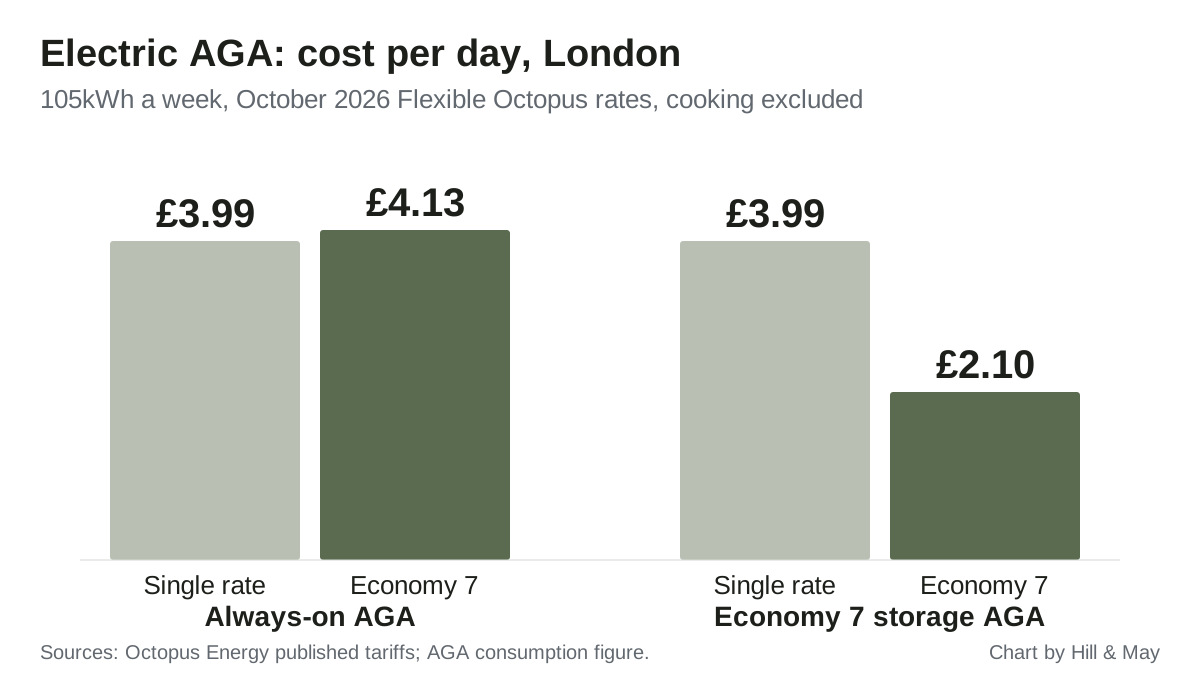
Look up Economy 7 rates for an AGA and most advice says the same thing: switch to off-peak and the cooker gets cheaper. For the AGA most people own now, that is wrong. An always-on electric AGA draws power evenly through the day and night, and on Economy 7 the 17 daytime hours are charged at a much higher rate than a single-rate tariff. At October 2026 rates, an AGA on the economy setting costs between 11p and 16p a day more on Economy 7 than on a standard tariff, depending on region, and it costs more in every region of Great Britain. Off-peak only pays if a large share of your whole household’s electricity lands in the night window. This page shows the rates, the break-even point and the few set-ups that genuinely save.
How Economy 7 is priced under the cap
Economy 7 gives you seven hours of cheaper electricity at night and charges more for the rest of the day. The exact hours depend on your meter and area, usually somewhere between 10pm and 8.30am.
Ofgem does not cap the day and night rates separately. Its price cap page says only that on multi-rate tariffs like Economy 7 the peak and off-peak rates together cannot cost more than the cap. Each supplier chooses its own split, which is why two neighbours on standard Economy 7 tariffs can pay different night rates.
For the figures below we have used Flexible Octopus, a standard variable tariff priced at or under the cap, because Octopus publishes every regional rate openly. These are monthly Direct Debit rates in force on 2 October 2026, with no VAT, because domestic electricity is zero-rated from 1 October 2026 to 31 March 2027. Other suppliers’ day and night splits differ by a penny or two, so check your own bill or your supplier’s tariff page.
Economy 7 day and night rates by region, October 2026
| Region | Day rate | Night rate | Single-rate tariff | Night share needed to break even | Always-on AGA per day, single rate | Same AGA per day, Economy 7 |
|---|---|---|---|---|---|---|
| Eastern England | 33.28p | 13.96p | 26.61p | 35% | £3.99 | £4.15 |
| East Midlands | 31.35p | 13.97p | 25.36p | 34% | £3.80 | £3.94 |
| London | 33.11p | 13.99p | 26.60p | 34% | £3.99 | £4.13 |
| Merseyside and North Wales | 34.44p | 15.00p | 27.86p | 34% | £4.18 | £4.32 |
| West Midlands | 31.73p | 14.09p | 25.60p | 35% | £3.84 | £3.99 |
| North East England | 31.65p | 13.72p | 25.46p | 35% | £3.82 | £3.96 |
| North West England | 32.89p | 14.08p | 26.49p | 34% | £3.97 | £4.11 |
| Southern England | 33.16p | 13.80p | 26.47p | 35% | £3.97 | £4.13 |
| South East England | 33.47p | 14.17p | 26.88p | 34% | £4.03 | £4.18 |
| South Wales | 33.01p | 14.26p | 26.55p | 34% | £3.98 | £4.13 |
| South West England | 33.20p | 13.91p | 26.58p | 34% | £3.99 | £4.14 |
| Yorkshire | 31.44p | 14.52p | 25.60p | 35% | £3.84 | £3.98 |
| South Scotland | 31.83p | 14.84p | 26.11p | 34% | £3.92 | £4.03 |
| North Scotland | 32.55p | 14.41p | 26.35p | 34% | £3.95 | £4.09 |
Standing charges are left out because they barely differ between the two tariffs. The AGA columns assume 105kWh a week, which is AGA’s own figure for a three-oven AGA Classic on its economy setting, spread evenly over 24 hours. Cooking is not included.
Why an always-on AGA loses money on Economy 7
The break-even column is the one to read. It shows what share of your electricity has to fall in the seven night hours before Economy 7 beats a single rate. Everywhere in the country it is 34% or 35%.
An always-on cooker that holds its temperature evenly uses electricity roughly evenly around the clock, so only 7 of every 24 hours, or 29%, of its use is at the night rate. That is short of the 34% you need. The other 71% is billed at the day rate of 31p to 34p instead of a flat 25p to 28p, and the cheap night hours do not make up the difference. In London the gap is 14p a day, or about £13 over the 92 days of the October to December cap.
It gets worse once you add the rest of the house. Economy 7 applies to the whole meter, so the kettle, the lights, the washing machine and the television are all on the day rate too. Unless you also run storage heaters, an immersion heater on a night timer, or charge an electric car overnight, most of that use falls in the day.
The cookers that do suit Economy 7
The original Economy 7 AGA. The first electric AGA, launched in the mid-1980s, was built for this tariff. It charged a core of storage bricks overnight to up to 725°C on a 32 amp cooker circuit, then a small fan moved the heat to the ovens and hotplates during the day. If the store ran low before the cheap rate came back, it boosted itself at a reduced level. According to AGA specialist TN Cook, it was discontinued on 31 May 2018. If you still have one, off-peak is exactly how it is meant to run.
Here the sums turn around. Put the same 15kWh a day entirely on the night rate and the London figure drops from £3.99 a day to about £2.10. Even after the rest of a typical household’s electricity (about 7.4kWh a day, if 80% of it is used in the day) moves to the higher day rate, the house is about £1.69 a day better off than on a single rate. On an Economy 7 AGA, staying on Economy 7 is worth around £600 a year.
A heat-storage cooker on a timer that matches your night hours. A cooker that genuinely stores most of its heat overnight and draws little in the day behaves like the Economy 7 AGA. A cooker that simply stays on at a steady temperature does not, whatever its marketing says about cast iron.
What about programmable electric AGAs?
The AGA eR7 and the earlier Total Control heat their ovens on a schedule you set, and you can switch zones off. That makes them far cheaper to run than an always-on model, but it does not make them good Economy 7 cookers. Most cooking happens at teatime, well outside the night window. Heating the ovens at 6am on the last of the cheap rate helps a little if you bake in the morning. Overall it rarely shifts enough of your total household use into the night to clear the 34% bar. Our AGA eR7 review covers how the programming works, and the AGA eR3 review covers the smaller model.
For these cookers a smart time-of-use tariff, which has a cheap window in the afternoon or several cheap periods, is more promising than old-style Economy 7. But the same logic applies: work out your night share from your own meter readings before you switch.
How to check your own night share
- Find a recent bill or your supplier’s app. If you already have Economy 7 or a smart meter, it shows day and night use separately.
- Divide the night units by the total units. That is your night share.
- Compare it with the break-even figure for your region in the table above.
- Below 34%, you are paying more on Economy 7 than you would on a single rate. Above 35%, Economy 7 is saving you money.
If you have a smart meter but are on a single rate, your supplier’s half-hourly data will show what share of use falls between midnight and 7am.
The whole-year picture
An AGA on the economy setting costs about £1,450 a year to run at October 2026 single rates. Economy 7 adds roughly another £50 to that unless something else in the house is using the night hours. For model-by-model annual figures see AGA running costs per year, and for this quarter’s gas and electricity figures on every type of range cooker see the October 2026 price cap rates. If you would rather put in your own numbers, use our running cost calculator.
These rates will change on 1 January 2027, when the next cap period begins. Ofgem announces it on 25 November 2026, and we will update the table after that.
Frequently asked questions
Is Economy 7 cheaper for an electric AGA? Not for an always-on AGA. It uses power evenly around the clock, so only about 29% of its use falls in the night window, short of the 34% to 35% needed to break even. At October 2026 rates it costs 11p to 16p a day more on Economy 7, depending on region.
What are Economy 7 rates in October 2026? On Flexible Octopus, day rates run from 31.35p to 34.44p per kWh and night rates from 13.72p to 15.00p, depending on region. Ofgem does not cap the day and night rates separately; each supplier sets its own split within the cap.
Which AGA was designed for Economy 7? The original Economy 7 AGA, also called the 30 amp or night storage AGA. It charged storage bricks overnight and released the heat during the day. AGA stopped making it on 31 May 2018.
Does Economy 7 work with an AGA eR7? It can, but it rarely saves money. The eR7 heats its ovens when you program it to, and most cooking happens in the evening when Economy 7 charges its higher day rate.
How do I know if Economy 7 is saving me money? Divide the night units on your bill by your total units. If more than about 35% of your electricity is used at night, Economy 7 is cheaper than a single rate. Below 34%, it costs more.
Does turning an AGA down overnight help on Economy 7? No. Turning it down at night moves even more of its use into the expensive day hours. On Economy 7 you want the opposite: as much use as possible at night.