Buying Guides
Kitchen Storage Units: Where the Extra 55% Actually Hides

Updated 2026
Most advice about kitchen storage units is decorative. Buy more baskets, use the vertical space, label the jars. None of it addresses the thing that actually decides how much a kitchen holds, which is the internal geometry of the units themselves: how deep they are, whether the fronts are doors or drawers, and how tall the sides of the pull-outs are. Blum, which makes the runners and lift systems inside a large share of British kitchens, publishes hard percentages for each of those decisions in its Dynamic Space planning literature, and they are worth more than any amount of tidying advice.
This page takes those published numbers, adds the load ratings and cabinet sizes each mechanism needs, and turns them into a plan you can hand to a kitchen designer. Sizes and unit types are covered separately in our kitchen cabinet sizes reference, and this page assumes those.
Start with zones, not with cupboards
Blum’s planning method divides any kitchen, regardless of size or shape, into five zones: consumables, non-consumables, cleaning, preparation and cooking. For a right-handed cook those should run clockwise around the room. For a left-handed cook, the reverse.
The zones are useful because they tell you what has to be near what, before you decide what kind of unit to use:
- Consumables. Food, tinned goods, dry stores, and the fridge. Everything within easy reach, which in practice means a tall larder rather than deep base cupboards.
- Non-consumables. Cutlery, crockery, glasses. Blum’s rule here is to put the dishwasher next to this zone, because that is the journey you make most often.
- Cleaning. Sink, dishwasher, waste, cleaning products. A sink base is not a good cupboard, so the storage that matters here is the bin pull-out.
- Preparation. The main work area, and Blum’s own guidance is that it should be at least 90cm of clear worktop. This is the number most small-kitchen plans break, usually by putting the hob too close to the sink.
- Cooking. Hob, oven, pans, utensils, baking trays. Deep drawers directly under the hob, not a cupboard.
If the zones are wrong, better cabinets will not rescue the kitchen. Sort the order first.
The three numbers that create space without moving a wall
These come straight from Blum’s Dynamic Space material, and they are the closest thing to hard data in kitchen planning:
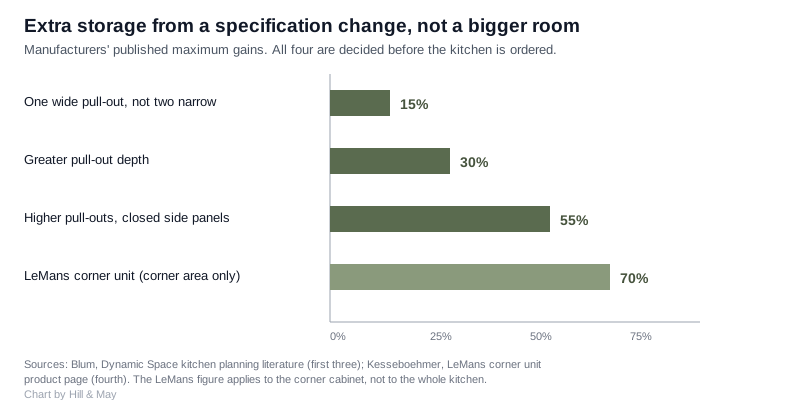
- A wide pull-out instead of two narrow ones: up to 15% more storage space. Two 300mm drawers have two sets of sides, two sets of runners and a carcase divider between them. One 600mm drawer has one of each. The material you delete becomes storage.
- Higher pull-outs with closed side panels: up to 55% more storage space. This is the big one, and the one most people leave on the table. A drawer with tall closed sides, rather than a low box with a rail above it, lets you stack to the top of the drawer instead of to the top of the box.
- Pull-outs with greater depth: up to 30% more storage space. A deeper carcase, where the room allows it, is free volume. Worth asking about if you are having units made rather than buying standard.
None of the three costs floor area. All three are decided at the specification stage and are close to impossible to retrofit.
Drawers below the worktop, doors above
Below the worktop, a drawer beats a cupboard every time, and the reason is not aesthetic. A cupboard makes you crouch, open a door, and then reach into a dark space you cannot see the back of. A full-extension drawer brings the contents out to you and shows the whole thing at a glance. Blum’s own framing of this is that drawers can be fully extended to give clear access to everything inside.
The exception is the sink base, where the plumbing is, and the appliance housings. Everything else in a base run is better as drawers, and the standard specification for a country kitchen is a shallow top drawer for cutlery and utensils with one or two deep drawers below for pans.
Above the worktop, doors are correct. You are reaching in at eye level and can see what is there.
Base unit sizes and the usual configurations are in our kitchen base units guide.
What each mechanism will carry
Load ratings decide whether a drawer full of cast iron sags in five years. These are the manufacturers’ published figures:
| Mechanism | Where it goes | Published capacity |
|---|---|---|
| Blum LEGRABOX, 40kg version | Standard base drawers | 40kg |
| Blum LEGRABOX, 70kg version | Pan drawers, heavy stores | 70kg |
| Blum SPACE TWIN | Narrow base pull-out | Up to 20kg per base cabinet |
| Kesseböhmer LeMans | Corner base unit | Trays rated in the region of 25kg each |
The two LEGRABOX capacities matter more than they sound. A 600mm drawer holding a Le Creuset casserole, two saucepans and a stockpot is not far off 25kg, and that is before anything else goes in. If you have cast iron or a range cooker’s worth of heavy pans, specify the 70kg runner in at least the deep drawers of the cooking zone. It is a specification line, not a different drawer.
SPACE TWIN is the mechanism for the narrow cabinet, the 150mm or 200mm gap at the end of a run that would otherwise be a filler panel. Blum’s SPACE TWIN page states that its diagonally offset runners give improved lateral stability and a load-bearing capacity of up to 20kg per base cabinet, and that it can be built with LEGRABOX, MERIVOBOX or TANDEMBOX. It is the right answer for oils, bottles and spices next to the hob, and a bad answer for anything heavy.
The corner, which is where kitchens lose most of their volume
A blind corner base unit is the single worst-performing cabinet in a standard kitchen. It is deep, it is dark, it opens at an angle, and the back third of it holds whatever was put there when the kitchen was fitted.
Kesseböhmer’s LeMans is the mainstream fix. Its organically shaped shelves swing out of the cabinet and towards you rather than rotating within it, and Kesseböhmer states it increases the storage area by up to 70%. That figure is the largest single gain available anywhere in a kitchen, and it applies to the cabinet nobody wants.
The alternatives are a corner drawer, which works but eats the adjacent run, or accepting the blind corner and using it for the things you genuinely use twice a year. What you should not do is fit a blind corner and plan to store anything in it that you need weekly.
Corner unit types and the geometry are covered in our kitchen corner units guide.
Tall units earn their footprint
A tall larder unit holds far more per square metre of floor than the equivalent run of base and wall units, because it uses the dead band between the top of the wall units and the ceiling, and the band below the base units. A pull-out larder tower, where the whole interior comes out to you rather than you reaching in, is the version worth paying for. Blum’s SPACE TOWER is the reference product here, and every major kitchen supplier has an equivalent.
Put it in the consumables zone, next to the fridge, and it becomes the pantry that a country kitchen with no actual pantry is missing. Sizes and the different tall unit types are in our tall kitchen units guide.
Where open shelving fits
Open shelves are not a storage solution, they are a display solution that holds some storage. They are excellent for the things you use daily and that look acceptable: everyday plates, mugs, a row of jars. They are poor for anything greasy, because everything within a couple of metres of a hob acquires a film, and they are poor for the fifteen items you use twice a year.
The practical split in a country kitchen is closed storage for volume, one run of open shelves for the things that earn their place. Load ratings and fixings for that run are in our kitchen shelving ideas page.
A specification you can hand over
If you want the short version to give a kitchen designer:
- Set the five zones in the right order for the hand you cook with, and protect 90cm of clear preparation worktop.
- Drawers everywhere below the worktop except the sink base and appliance housings.
- Specify high-sided pull-outs, not low boxes with rails. This is the 55%.
- One wide drawer rather than two narrow ones wherever the run allows. This is the 15%.
- Ask whether deeper carcases fit the room. This is the 30%.
- 70kg runners in the deep drawers of the cooking zone if you own cast iron.
- A proper corner mechanism, not a blind corner, unless the corner is genuinely for seasonal storage.
- A pull-out larder tower in the consumables zone.
- A narrow pull-out rather than a filler panel wherever a gap of 150mm or more is left over.
Frequently asked questions
Are drawers really better than cupboards in kitchen storage units? Below the worktop, yes. A full-extension drawer presents its whole contents at once, where a cupboard makes you crouch and reach into a space you cannot see. Above the worktop, doors are fine, because you are already at eye level.
How much more will high-sided pull-outs actually hold? Blum’s published figure is up to 55% more storage space compared with lower pull-outs, because you can stack to the top of the drawer rather than to the top of a low box. It is the largest gain available from a single specification choice below the worktop.
What weight can a kitchen drawer take? Blum’s LEGRABOX comes in 40kg and 70kg load-bearing versions. A deep drawer holding cast iron pans can approach 25kg on its own, so the 70kg version is worth specifying in the cooking zone even though most kitchens are quoted with the 40kg.
What is the best storage for a blind corner unit? A pull-out corner mechanism. Kesseböhmer states its LeMans shelves increase the storage area by up to 70%, because the shelves swing out towards you rather than rotating inside the cabinet where the back stays unreachable.
What can I do with a narrow gap at the end of a kitchen run? Fit a narrow pull-out rather than a filler panel. Blum’s SPACE TWIN is rated at up to 20kg per base cabinet and suits bottles, oils and spices. Do not put anything heavy in it.
How wide should the preparation area be? Blum’s guidance is at least 90cm of clear worktop in the preparation zone. That is the space between the sink and the hob in most layouts, and it is the measurement small kitchens most often sacrifice.
Do I need to replace the units to get any of this? Not always. Corner mechanisms and internal pull-outs can be retrofitted into existing carcases if the internal dimensions suit. The depth and side-height gains cannot, because they are properties of the carcase and the drawer box, which is why they belong on the specification list before anything is ordered.