Range Cooker Buying Guides
Best Budget Range Cookers Under £1,500
By the Hill & May team
Updated 2026
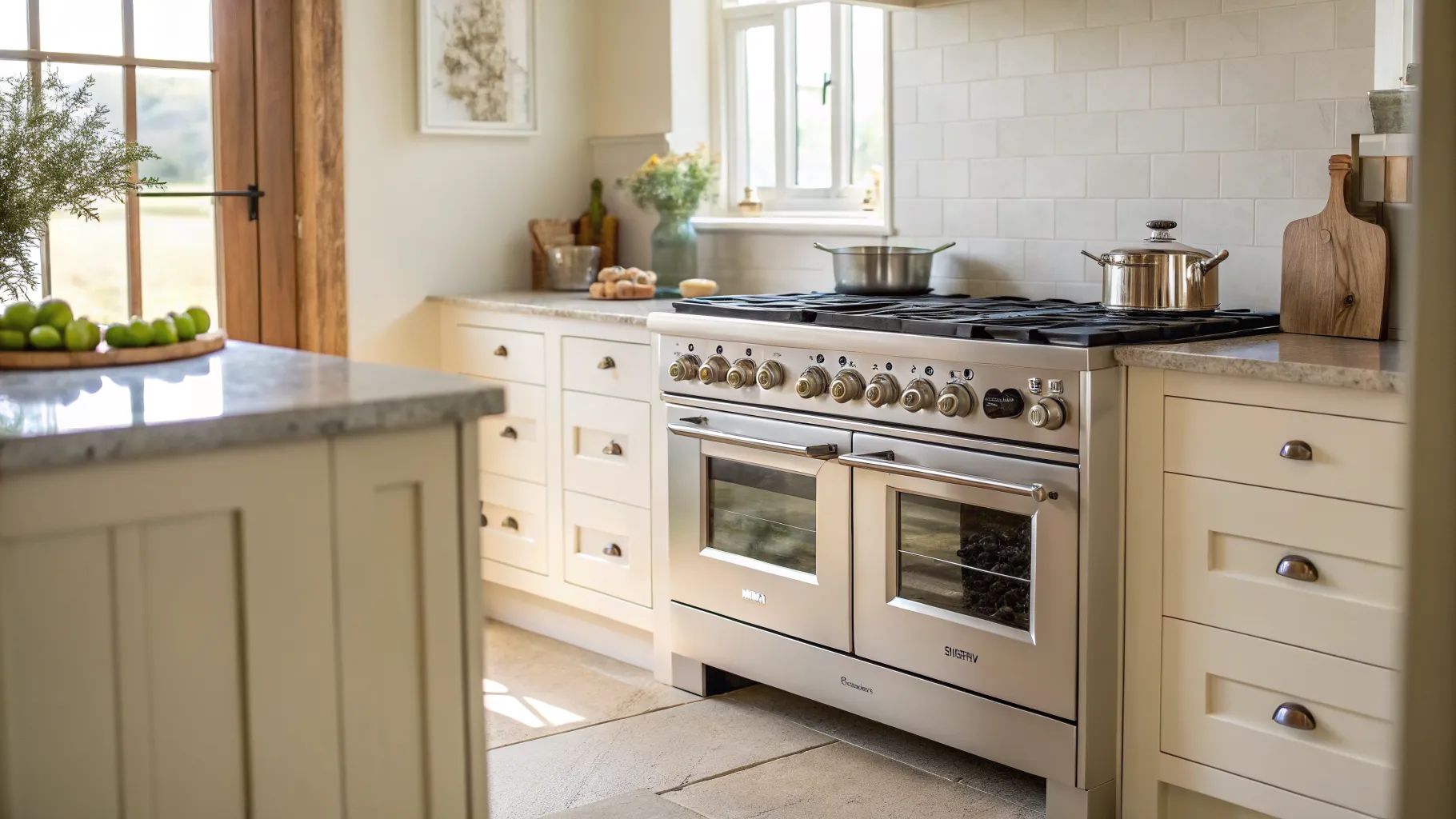
Set your ceiling at £1,500 and you have more room than you think. Genuinely good 90cm and 100cm range cookers from brands people recognise, Belling, Stoves, Leisure, Flavel and DeLonghi, sit comfortably under that budget. That leaves headroom for the parts most buying guides skip: delivery, getting the old appliance taken away, and the gas or electrical work that turns a boxed cooker into a working one.
So the first useful thing to say is that you do not need to spend the full £1,500 on the cooker itself. Sub-£1,500 is mainstream-brand territory, not premium. Rangemaster’s smallest Classic sits at the lower end of this budget, but most of the Rangemaster range, along with AGA, Falcon, Bertazzoni and Lacanche, sits above it. Knowing that up front stops you chasing a badge you cannot afford and helps you spend the money where it actually improves your cooking.
Spend your budget like this
A range cooker is one of three or four line items, not one. Plan for all of them before you commit:
- The cooker: a credible 60cm, 90cm or 100cm model fits well inside the budget. For a family kitchen, a 100cm dual fuel is the sweet spot.
- Gas connection: a Gas Safe registered engineer must make the gas connection. This is a legal requirement, not optional. Budget for it separately.
- Electrical work: most ranges need a dedicated circuit (more on this below). If your kitchen does not already have the right cable and isolator, you need a qualified electrician.
- Delivery and removal: check whether the retailer takes the old appliance away, disconnects it, or charges extra for both.
Get quotes for the install before you buy, because a cheaper cooker that needs a new circuit run can end up dearer than a pricier one that drops into existing wiring.
Widths: the spec that matters most
Range cookers are sorted by width, and width decides almost everything else: how many ovens you get, how big they are, and how many burners sit on top.
| Width | What you get | Best for |
|---|---|---|
| 60cm | Two ovens in a compact body, fits a standard cooker gap | Small kitchens, the entry point |
| 90cm | Two ovens plus grill, usually a 5-burner hob | The popular family size |
| 100cm | Two ovens plus a separate grill cavity, hob up to seven burners | The most workable family layout |
| 110cm | The largest mainstream size | Big kitchens, usually above this budget when dual fuel or induction |
The 60cm “mini range” is the honest choice if your kitchen has a standard cooker gap and you just want the range look with two cavities. The 110cm models, like the Belling Cookcentre 110, tend to climb above this budget once you add dual fuel or induction, so they sit just outside this guide.
90cm or 100cm: the part nobody tells you
Here is the detail that separates a useful guide from a spec sheet. A 100cm range is effectively the blueprint; a 90cm range is that same layout shrunk 5cm on each side. The casualty is the right-hand oven, which on a 90cm model is noticeably narrow. Real owners describe it as just a touch too snug. It handles chicken breasts, chips and jacket potatoes perfectly well, and the large left oven does your roasts and casseroles, so a 90cm works fine if you mostly cook in one oven at a time.
If you want two genuinely usable ovens running together at Christmas, the extra 10cm of a 100cm model is worth it. Among the 90cm options, the Stoves Sterling 90 is worth a look if you are set on 90cm but worried about space, as Stoves fits one of the largest tall ovens available at this width. For a wider comparison at that size, see our guide to the best 90cm range cookers; if the extra width appeals, the best 100cm range cookers page goes deeper on the layouts.
Fuel types: what is cheapest to buy and to run
| Type | What it is | Notes |
|---|---|---|
| Dual fuel | Gas hob plus electric fan oven | Most popular configuration; responsive flame on top, even oven heat. Slightly dearer than all-gas |
| All-gas | Gas hob and gas oven | Traditionally cheapest to buy and to run; needs mains gas or LPG for off-grid homes |
| Electric | Fan ovens with ceramic or induction hob | The choice for homes with no gas supply |
| Induction (hob) | Magnetic-field hob | Fastest and most efficient hob, but needs iron-based pans and often a bigger electrical supply |
Two rules help here. Gas ovens are cheaper to run than electric ovens, but induction hobs are far more efficient than gas hobs because little heat is lost to the surrounding air. That is exactly why dual fuel is the default: you get the responsive gas flame on top and the even electric oven below. The genuinely cheapest combination to run would be a gas oven paired with an induction hob, but that pairing is rare, so most dual fuel you see is the standard electric-oven, gas-hob setup.
If you go induction, factor in pans. Induction only works with iron-based, magnetic cookware, so old aluminium or copper pans will not heat. Hold a fridge magnet to the base of your existing pans; if it sticks, they will work.
What it costs to run
A range cooker costs on average around £60 a year to run, with most models falling between roughly £45 and £89 a year, based on Which? 2024 data compiled by Appliance City. For context, Which? puts the average gas freestanding cooker at around £29 a year, while electric and dual fuel freestanding models average closer to £58, with the priciest reaching about £75.
To estimate any single appliance, the formula is simple: appliance watts multiplied by hours used, divided by 1,000, gives kWh; multiply that by your unit rate. Use the current Ofgem price cap unit rate as your anchor rather than a guessed figure, and check the rating plate on the cooker for its wattage. The Energy Saving Trust keeps current home-appliance energy advice if you want to dig into the numbers.
The energy label nuance most guides get wrong
You may have read that energy labels were rescaled to a clean A-to-G scale in 2021. That change hit fridges, freezers, dishwashers, washing machines, washer-dryers and televisions, but ovens were not part of it. Range cooker ovens still carry the older A+++ to D style scale, so seeing a label that reads “A” or “A+” is normal and correct, not a sign of an old listing. The oven label also shows oven volume in litres and energy per cycle in kWh, for both conventional and fan modes. The legal basis sits in Commission Delegated Regulation (EU) No 65/2014, retained in UK legislation. Do not penalise a cooker for not having the new A-to-G oven label, because that label does not exist for ovens.
The electrical supply: not a plug
This catches people out more than anything else. Most range cookers draw more than 3kW, which is too much for a standard 13A plug socket. They need a dedicated radial circuit, hard-wired through a cooker switch or outlet plate. The common UK setup is 6mm cable on a 32A breaker, with 10mm cable on a 45A breaker recommended for headroom, especially for induction and all-electric models that pull the most power.
Practically, that means:
- Dual fuel and gas models need a Gas Safe engineer for the gas, plus usually a nearby 13A socket for the ignition, timer and clock.
- All-electric and induction models need the bigger dedicated supply; always check the rating plate against your existing circuit.
- Any electrical work falls under Part P, so it must be done by a qualified electrician who tests the circuit, confirms the protective device is correctly rated, and checks the isolator.
If your old cooker was already hard-wired on a 32A circuit, you may be able to reuse it. If you are moving from a freestanding electric cooker on a smaller circuit, or adding induction, budget for an upgrade. The full process is covered in our range cooker buying guide.
Will it actually fit
Measure twice. Two separate checks matter:
- The gap. A 100cm range needs a 100cm gap with a little tolerance, and the same logic applies at every width. Check the height against your worktop and the depth against your units.
- The route in. A 100cm cooker is heavy and rigid. Measure every doorway, the hallway turn and any tight corner between the front door and the kitchen. Plenty of buyers get the gap right and then cannot get the appliance through the door.
Budget models worth shortlisting
Specs and availability drift, so treat these as starting points and confirm the current price and live spec with the manufacturer or a major retailer before you buy, as ranges get revised.
Belling Cookcentre 100DF (100cm dual fuel). The most cooking space for the money pick. Around 157 litres across three cavities: a main fanned oven with an AirFry function, a conventional second oven, and a separate grill cavity. The seven-burner gas hob includes a 4kW wok burner, and it comes with a 3-year parts and labour warranty, which is unusually generous at this end. Made in Britain.
Stoves Richmond 900DFT (90cm dual fuel). A British-made classic-styling option with three electric ovens, a 5-burner hob including a 3.5kW wok burner, cast iron pan supports and a multifunction main oven. A 60cm Richmond is also available if you want the same look in a compact body.
Leisure Cuisinemaster CS100F520 (100cm dual fuel). A big-capacity 100cm with three ovens plus a dedicated grill, a 5-burner gas hob with a wok burner, an electric fan main oven of around 58 litres with stay-clean liners, and an A energy rating. Note that the Leisure cooker brand is owned by Beko, not Rangemaster.
Flavel Milano 100 (100cm dual fuel). Often the cheapest credible 100cm, frequently discounted or sold as graded stock. Seven gas burners including a wok burner and around 110 litres across two large electric ovens, in black and chrome. Also a Beko-owned brand.
DeLonghi 90cm dual fuel. The style-on-a-budget angle, and one of the cheapest entries overall: single-cavity models start lowest, with Professional twin-cavity and retro Vintage three-cavity versions above. All use a pro-style 5-burner hob with cast iron pan supports.
Rangemaster Classic 60 (60cm). The budget way into the Rangemaster name for a small kitchen, as the brand’s entry model. If a Rangemaster badge matters to you, this is how you get one within budget; our AGA vs Rangemaster comparison explains where the brand sits.
Who owns these brands, and why it matters
Brand history has shifted, and an old assumption can mislead you. Belling, Stoves and the New World cooker brand are part of Glen Dimplex Home Appliances, and Stoves and Belling cookers are made in Prescot, Merseyside, a genuine selling point if British manufacturing matters to you. The Leisure cooker brand and Flavel are now owned by Beko, so the old line that “Leisure equals Rangemaster quality” no longer holds. AGA, Rangemaster, Falcon and Mercury sit under the AGA Rangemaster Group. None of this makes one cooker better than another on its own, but it explains why two badges that once meant the same thing now sit in different camps.
Reliability: buy on warranty and service, not burner count
Budget range cookers are model-dependent, so be honest about the risks. Across the budget brands, owners report noisy oven fans that run on after cooking, door seals that do not sit flush, the narrow right-hand oven on 90cm models, trays that are awkward to fit, crumbs trapped behind fixed air grates, and the occasional gas-valve fault.
It is not all bad news: plenty of owners run Belling and Leisure units trouble-free for years. Which? notes that only a select few cookers earn its Best Buy badge for rapid, consistent heating, which tells you something useful: even, reliable heat and good UK after-sales service matter far more than the headline burner count. Favour a brand with a decent warranty and a real UK service network, and the Belling Cookcentre’s 3-year cover starts to look like more than a marketing line. For the wider field, our best range cookers for 2026 roundup ranks models across budgets.
Frequently asked questions
Do I need to spend the full £1,500 on a range cooker? No. Credible 60cm, 90cm and 100cm models from Belling, Stoves, Leisure, Flavel and DeLonghi sit comfortably under £1,500, with a 100cm dual fuel the sweet spot for a family kitchen. Keep the rest of the budget for delivery, removal and installation.
Is a 100cm range worth it over a 90cm? If you want two genuinely usable ovens at the same time, yes. The right-hand oven on a 90cm model is noticeably narrow because the layout is the 100cm shrunk 5cm each side. A 90cm is fine if you mostly cook in one oven; a 100cm gives you two workable cavities.
Which fuel type is cheapest to buy and to run? All-gas is traditionally cheapest both to buy and to run. Dual fuel costs a little more but is the most popular because the gas hob is responsive and the electric oven heats evenly. Induction hobs are the most efficient on top but cost more and need magnetic pans.
Do range cookers need a special plug? Most do not use a plug at all. They draw more than 3kW, so they need a dedicated radial circuit, usually 6mm cable on a 32A breaker, hard-wired through a cooker switch. Induction and all-electric models often want 10mm cable on a 45A breaker. Check the rating plate.
Do I need a Gas Safe engineer to install it? Yes, for any gas connection. Using a Gas Safe registered engineer is a legal requirement. Electrical work must be done by a qualified electrician under Part P, and the two jobs are often handled separately.
How much does a range cooker cost to run per year? On average around £60 a year, with most models falling between roughly £45 and £89 depending on type and how much you cook. Gas ovens tend to cost less to run than electric ones.
What energy rating should I look for? Oven labels were not rescaled in 2021, so range cooker ovens still use the older A+++ to D style scale. A rating of A or A+ is normal and good. Do not expect the new A-to-G label that fridges and washing machines now carry.
What warranty do budget range cookers come with? Two years is typical at this price. The Belling Cookcentre is a standout with 3 years parts and labour. A longer warranty and a real UK service network are worth more than an extra burner or two.